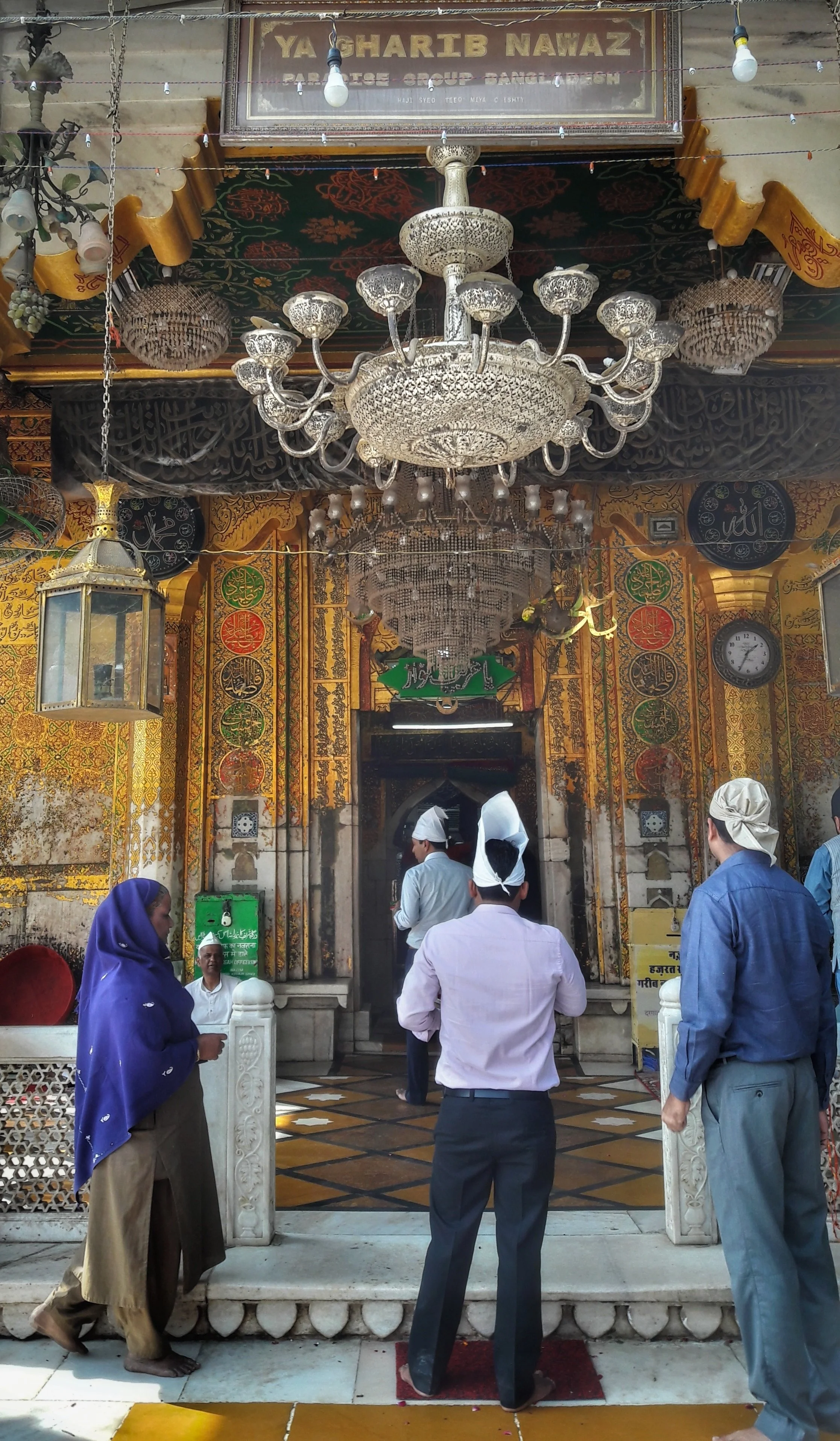
Devotees at the Dargah (shrine) of Muin al-Din Chishti, Ajmer, ca. 2019.
My ongoing book project, The Shrine's City: Pilgrimage, Politics, and the Making of Colonial Ajmer, c. 1857-1947 conceptualizes an urbanism wherein historic tombs of Sufi saints became important sites of British imperial governance in the Indian Ocean world. It looks at the dargah (tomb complex) of Muin al-Din Chishti (d. 1236 CE) in western India's Ajmer as a shared, palimpsestic, public space helmed by pilgrims, patrons and functionaries that continued to provide parallel forms of cultural and political currency during the Raj, and after. Moving away from traditional hagiographic and doctrinal discourse, this book explores how Sufi sacrality has been constantly re-imagined and re-activated to produce new, shifting alliances among citizens, religious leaders and governments in colonial and postcolonial cities.
***the research has been made possible by Stony Brook Foundation Board of Trustees Dissertation Completion Endowed Fellowship, the Charles Wallace India Trust Research Grant, Royal Historical Society England Research Travel Award, Presidential Critical Research Funds Stony Brook, Edward Guiliano' ‘78 PhD Global Fellowship, and Stony Brook History Department Dissertation Writing/Research Grant.
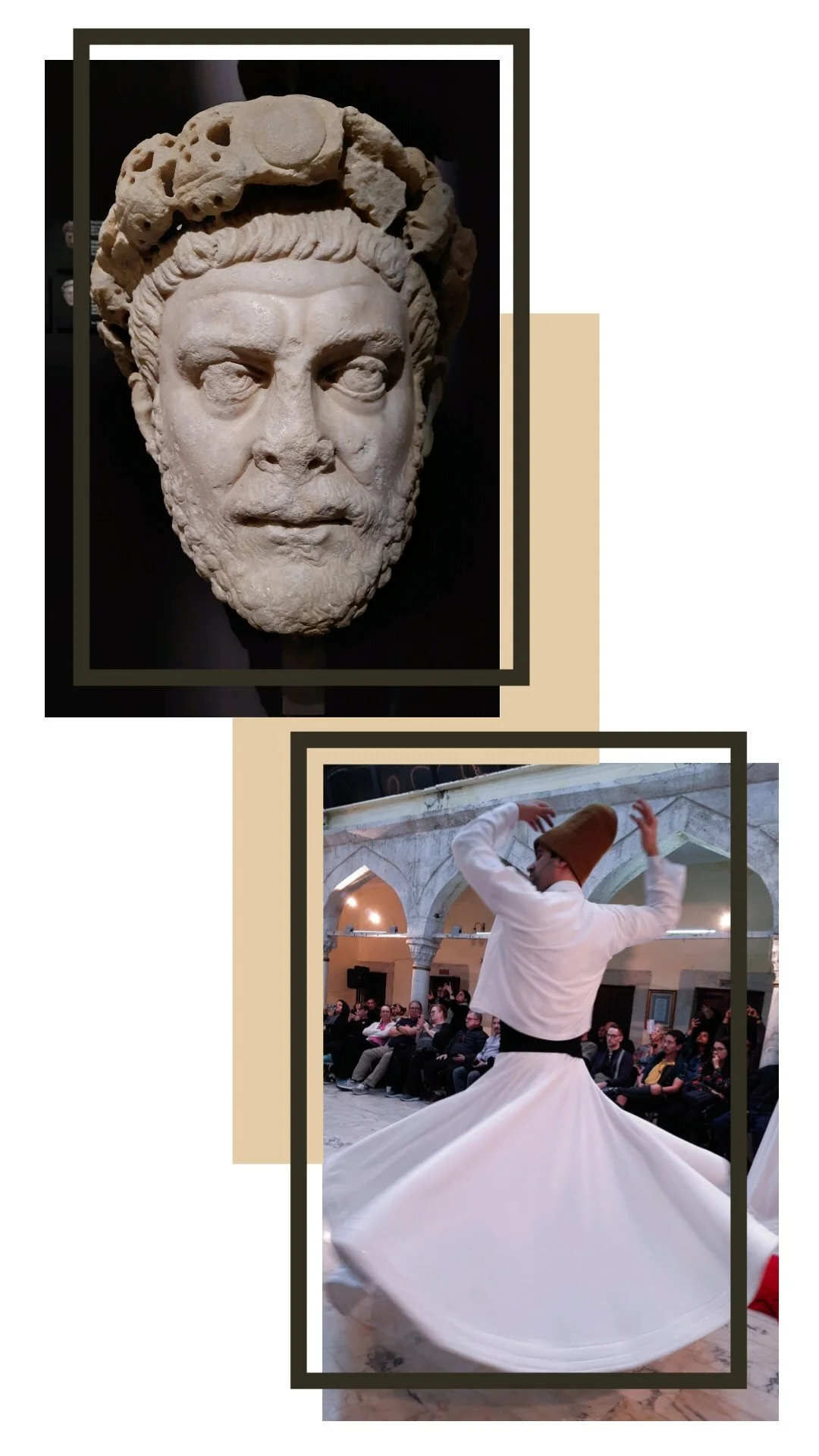
Mevlevi Sufi (Whirling Dervish) in Istanbul, ca. 2023
Greco-Roman figure, Istanbul Archaeological Museum, ca. 2023
Over the last decade I have written extensively on art, religion, photography, cinema, architecture, cities, communities, oral traditions, culinary practices and textiles for various domestic and international publications ranging from academic journals to lifestyle magazines.
It’s all about the inter-textuality and trans-regional connections!
I’m deeply interested in the ways in which we can think more productively (and pro-actively) about urban spaces through historical and contemporary rituals, beliefs and material cultures. Centuries of colonization and imperialism between 1500-1950 CE are particularly ripe for inter-disciplinary dialogue across History, Literary Studies, Anthropology and Social Sciences, which have, until recent years, been practised in silos.
I also find that this period, with its plethora of extant sources, is suitable for multimodal inquiry across written records, oral traditions, and art and architectural histories — which is key to my own praxis.
Select Publications:
Gupta, Aishani. “Stories, theatre and worship: The sacred masks of Majuli,” Garland Magazine (2025)
Gupta, Aishani. “The sacred and the spectacular: how Bengal’s Durga Puja pandals morph into temporary art galleries,” Garland Magazine (2024)
Gupta, Aishani and Sengupta, Ramyani. “Nationalist Aesthetics meet European Design: Inside the home of Sir Jagadish Chandra Bose and Lady Abala Bose,” The Heritage Lab (2024)
Gupta, Aishani. “Women of the Empire at Ajmer’s Dargah: Negotiating Sacred and Civic at a Prominent Sufi pilgrimage Site, 1900-1920,” Gender & History Vol 37, no. 1 (2023): 282-298
Gupta, Aishani and Jhala, Parakram Singh. “Heritage Art Conservation with Brijeshwari Kumari Gohil,” Rajputana Collective Vol. 1 no. 6 (2019): 60-62
Gupta, Aishani and Sanyal, Pooja. “Love and Lust in Bollywood’s Shakespeare: Rati and Sringara in Vishal Bhardwaj’s Film Adaptation of Macbeth,” The Shakespeare Institute Review 3 (2017): 20-28
Gupta, Aishani. "People’s History of Pakistan: Project Coke Studio." Thaap Journal (2016): 22-35
Find me on Instagram,
where I write about Cinema, Art, Politics and Culture — and a whole host of things that interest me!